
About this department
Molecular investigations look for a specific part of an infectious agent’s DNA or RNA in an appropriate specimen. They can support diagnosis, follow-up and, in selected cases, measurement of viral genetic material. The exact test, sample and reporting time must be confirmed before collection.
PCR, Real-Time PCR and RT-PCR
| Test or area | Details |
|---|---|
| PCR | Amplifies a specific DNA target so that it can be detected. |
| Real-Time PCR (qPCR) | Monitors amplification using a fluorescent signal. Depending on the assay, it can be qualitative or quantitative; it is not always a viral-load test. |
| Reverse transcription PCR (RT-PCR) | Converts RNA into complementary DNA before amplification. Reverse transcription and real-time monitoring are different processes that may be combined in one assay. |
Technology and quality
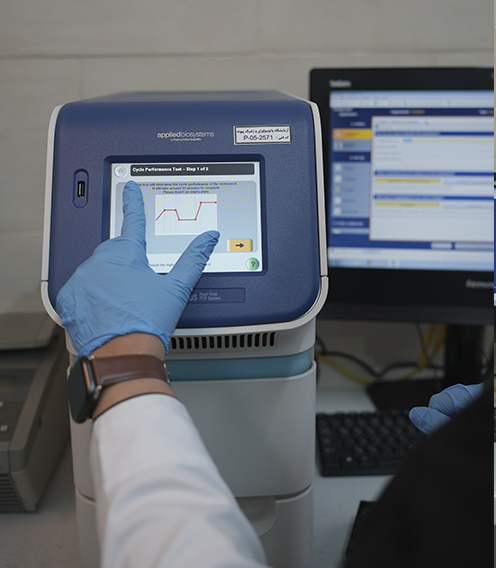
The laboratory’s equipment includes Real-Time PCR thermocyclers, DNA/RNA extraction systems, a sequencing system listed as CXCl3500 and specialist microscopes. These tools have different roles and are not all used for every virology test. Extraction quality, assay controls and prevention of cross-contamination affect reliability. An inhibited or invalid result may require further work or recollection.
Applications in infection testing
- HPV assays investigate selected viral DNA or RNA targets. Some identify high-risk types or particular genotypes. HPV testing is different from a Pap smear, and a positive HPV result alone is not a cancer diagnosis.
- HBV DNA and HCV RNA assays can investigate viral genetic material in appropriate clinical circumstances. Quantitative viral-load tests differ from qualitative tests.
- Selected respiratory molecular tests investigate a specified target in an appropriate respiratory specimen. A negative result may not exclude infection if collection timing or specimen quality is unsuitable.
Confirm the exact test
These are applications of molecular technology, not confirmation that every assay or specimen is currently accepted. Confirm the active test, target and specimen with the laboratory before attending.
How methods differ
| Test or area | Details |
|---|---|
| PCR / NAAT | Detects the target DNA or RNA sequence. |
| ELISA / immunoassay | Detects antigen or antibody, depending on the test. Timing and immune response can affect interpretation. |
| Culture | Investigates growth of an organism in suitable conditions. It is not interchangeable with every molecular test. |
Molecular infection testing and genetics
Infectious molecular testing targets an organism. Medical genetics examines human gene or chromosome changes, and cytogenetics investigates chromosome number and structure. Related technologies may be used for different diagnostic questions.
Preparing for collection
- Bring the exact test name or prescription; “PCR” alone does not specify the target or specimen.
- Tell the laboratory about antiviral medicines and when treatment began. Do not stop medicines yourself.
- Confirm sample type, collection container, transport conditions and any test-specific restrictions.
- Not all PCR tests require fasting. Bring previous results when relevant, particularly for viral-load comparisons.
Understanding results
Detected/positive means the test target was found in that specimen. It does not alone establish disease severity, infectiousness or a need for treatment. Not detected/negative means the target was not detected within the method’s limits. Quantitative results may use IU/mL or copies/mL. A Ct value from a qualitative assay is not automatically a measure of viral load or infectiousness. Review findings with your physician.