
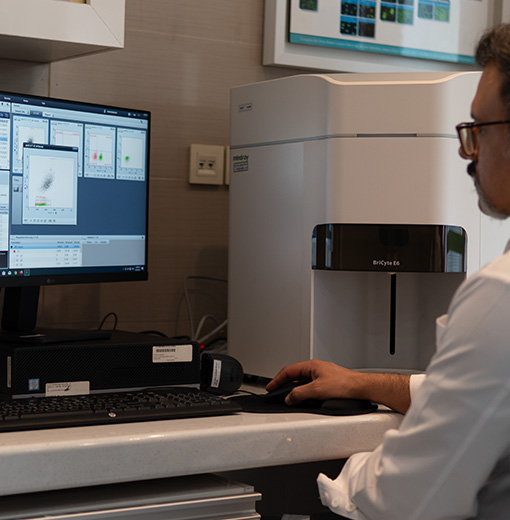
About this department
Flow cytometry measures physical cell characteristics and specific markers. Fluorescently labelled antibodies help identify surface or intracellular antigens. Panels are chosen according to the physician’s request, specimen and diagnostic question. It is not a general cancer screening test, and a single marker does not determine a diagnosis.
Tests and panels
| Test or area | Details |
|---|---|
| NK and NKT cells | CD3, CD16 and CD56 |
| Neutrophil oxidative burst / CGD investigation | DHR |
| High-sensitivity PNH panel | FLAER, CD157, CD64, CD15 and CD59 |
| T-cell subsets and CD4/CD8 ratio | CD3, CD7, CD4 and CD8 |
| Platelet glycoprotein expression | CD42b, CD42a and CD41/CD61; used in selected platelet disorder investigations |
| Leukocyte adhesion deficiency | CD11b, CD15 and CD18; LAD-II may require additional markers |
| B-cell light-chain restriction | Surface kappa and lambda |
| Hereditary spherocytosis investigation | EMA binding test |
| HLA-B27 assessment | HLA-B27 with CD3 as listed in the source; positivity alone is not diagnostic |
| B-cell enumeration | CD19 and CD20 |
| CD34+ stem cell enumeration | CD34 and CD45 |
Leukemia and lymphoma immunophenotyping
Marker patterns can help investigate B-cell, T-cell and plasma cell disorders, B-ALL, T-ALL and AML. Source examples include CLL/SLL, Burkitt, diffuse large B-cell, follicular, hairy cell, mantle cell and marginal zone disorders, and multiple myeloma. AML descriptions include myeloblastic, promyelocytic, myelomonocytic, monocytic, erythroid and megakaryoblastic forms; classification requires the complete diagnostic picture.
Specimens
Depending on the investigation, peripheral blood, bone marrow aspirate, suitable cell suspensions from lymph node or other tissues, or selected body fluids such as CSF may be used. Specialist specimens require advance confirmation because collection, storage and transport can be time-sensitive.
Preparing for your test
- Bring the exact panel or prescription. “Flow cytometry” alone does not identify which markers are required.
- Tell the physician and laboratory about immunosuppressive medicines, corticosteroids, chemotherapy or targeted treatment. Do not stop medicines yourself.
- Coordinate bone marrow, fluid or tissue collection and delivery before sampling. Do not assume invasive collection is performed at the laboratory.
- Bring previous CBC, pathology, flow cytometry and other relevant reports as requested.
Results and reporting time
Results are interpreted with blood counts, morphology, tissue or bone marrow findings and, where needed, genetic and molecular investigations. An abnormal cell population or marker change does not automatically mean malignancy. Reporting time depends on the panel and any further investigations.
Common questions
How is flow cytometry different from a CBC?
A CBC counts and characterises blood cells in a general blood profile. Flow cytometry examines selected cell populations and markers for specific diagnostic questions.
Is it only used for leukemia and lymphoma?
No. It also supports selected immune, PNH, platelet and stem cell investigations.
Do I need to fast?
Many blood-based flow cytometry tests do not require dedicated fasting. The exact test and any other requested tests determine your preparation.